A Bounded-Memory Testbed for Long-Horizon LLM Agents
Memory for a long-horizon agent is a contract about what each future
decision is allowed to see. AgenticSTS makes that contract bounded,
typed, and ablatable — and releases a reproducible Silent A0 benchmark in
Slay the Spire 2 where this design wins games that tested public
transcript agents did not.
bounded prompt · independent of run length5 typed layers · each ablatable298 released trajectoriesmodel-agnostic · Gemini · GPT · Qwen · Claude
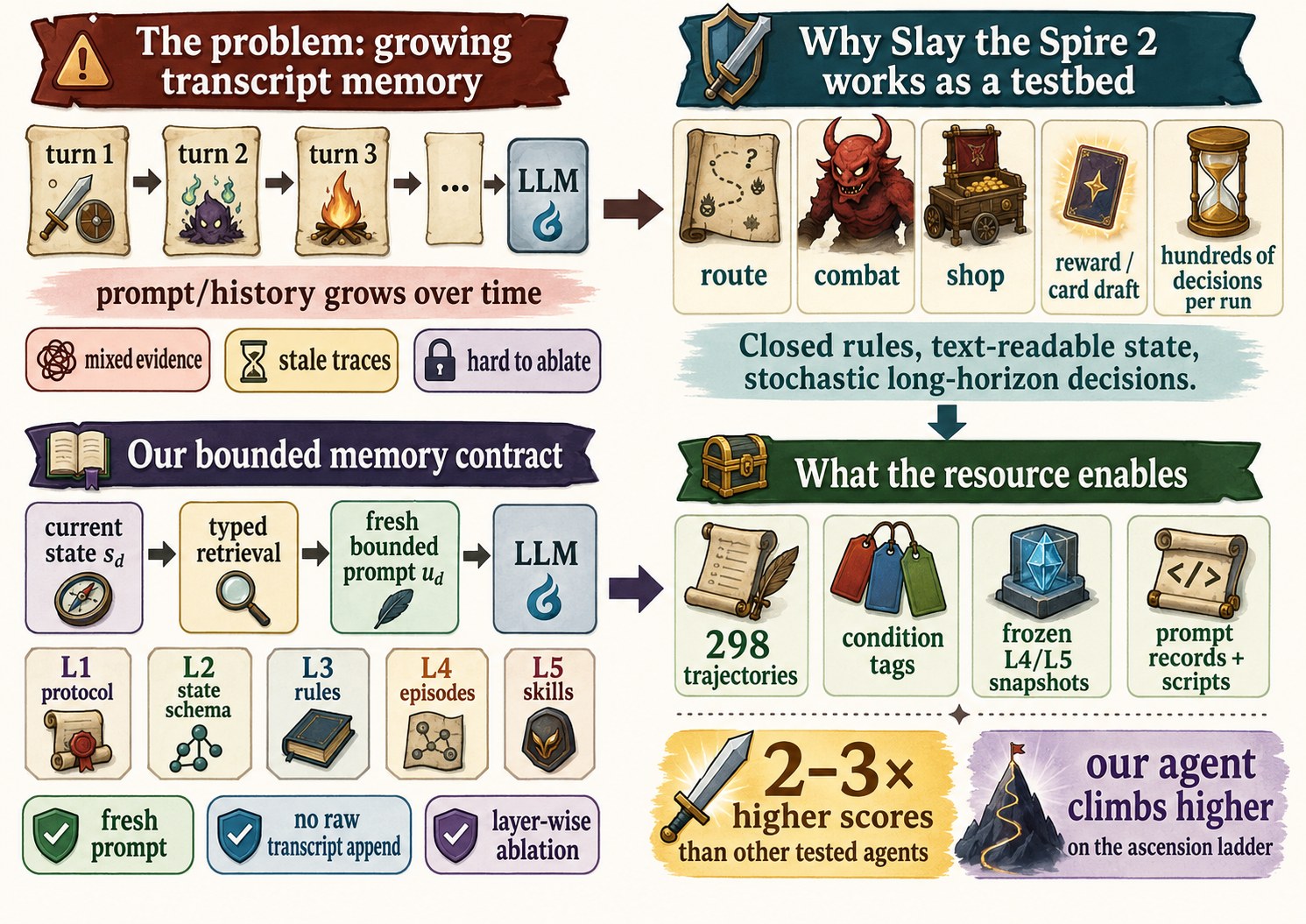
The problem (unbounded transcript memory), the bounded contract, why Slay the Spire 2 is a long-horizon testbed, and what the release provides.
Unedited gameplay
Watch it play
The agent driving real runs — combat, elites and bosses, map routing, shops, events, rest sites, card rewards, and run outcomes.
Abstract
The opposite of “append everything”
Most long-horizon LLM agents use the simplest memory contract: append everything — past observations, tool calls, reflections — to every prompt. Context grows without bound, stale traces re-enter decisions, and when the agent improves, no one can say which memory component did it.
AgenticSTS implements the opposite contract. Every decision is made from a fresh user message assembled by typed retrieval from five knowledge layers — no raw cross-decision transcript is ever appended. The prompt stays bounded across runs of any length, and any single layer can be ablated in isolation. We instantiate this in Slay the Spire 2, a closed-rule stochastic deck-building game whose runs demand hundreds of tactical and strategic decisions. The task is hard but unsaturated:
Setting
A0 win rate
Frontier LLMs — public AGI-Eval benchmark, 5 configs
0 wins (max defeat floor 33)
Human players — developer-reported, 240M community runs
External numbers (AGI-Eval, community human win rate) calibrate difficulty only; they are not matched baselines.
Method
The bounded memory contract
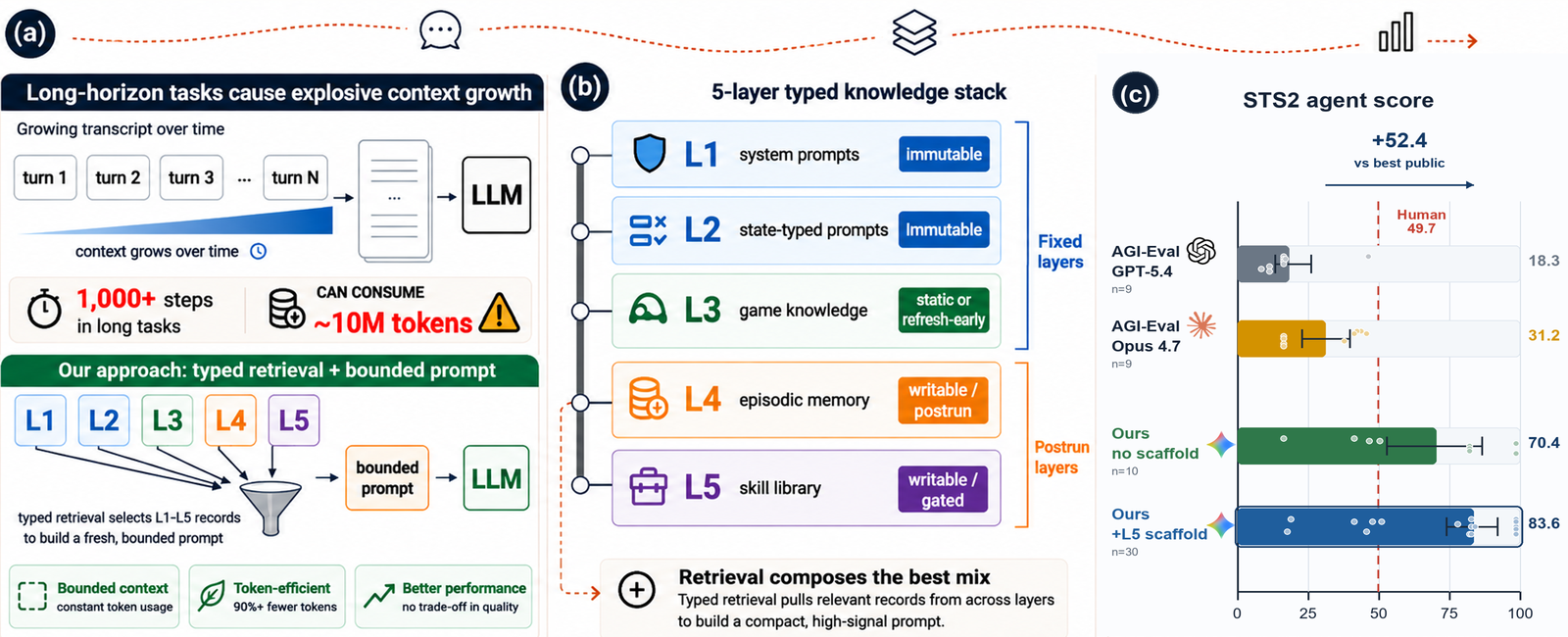
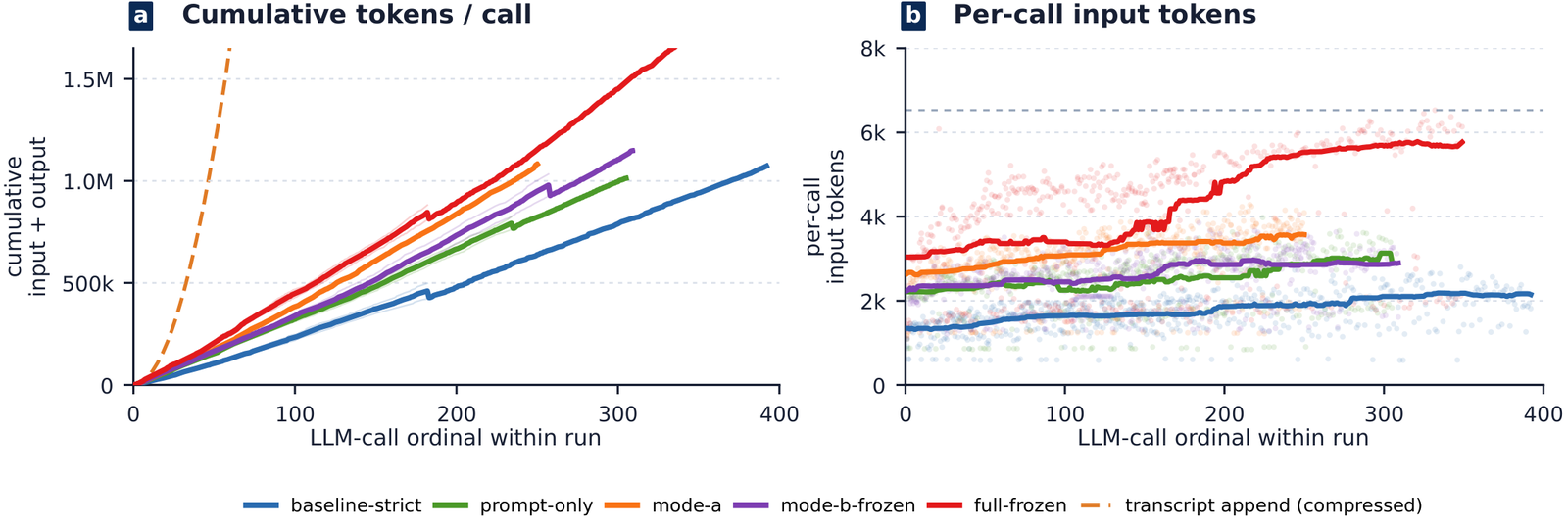
Each decision prompt is composed as u_d = π(L1, L2(s), L3(s), L4(s), L5(s)). With capped top-k retrieval, prompt size is independent of run length — where a transcript interface grows unbounded.
Left: long-horizon tasks blow up transcript context. Center: the five typed layers, each independently mutable. Right: STS2 score lift from the typed stack.
Raw game logs are not used as similarity RAG — near-identical-looking states can have opposite strategic meanings (card order, relic combos, route history). The agent retrieves summaries and triggered guides, not nearest-neighbor log snippets. A dispatcher routes decisions to four model tiers (fast, strategic, analysis, evolution); four static system prompts stay cacheable while all per-run state lives in the user message — a median of 67 strategic LLM calls per run rather than one call per in-game action.
Token audit on ten fixed-A0 runs: per-call prompt size stays flat; the dashed line is a transcript-appending counterfactual at ¼ of naive O(c²) growth.
Results
What the layers buy
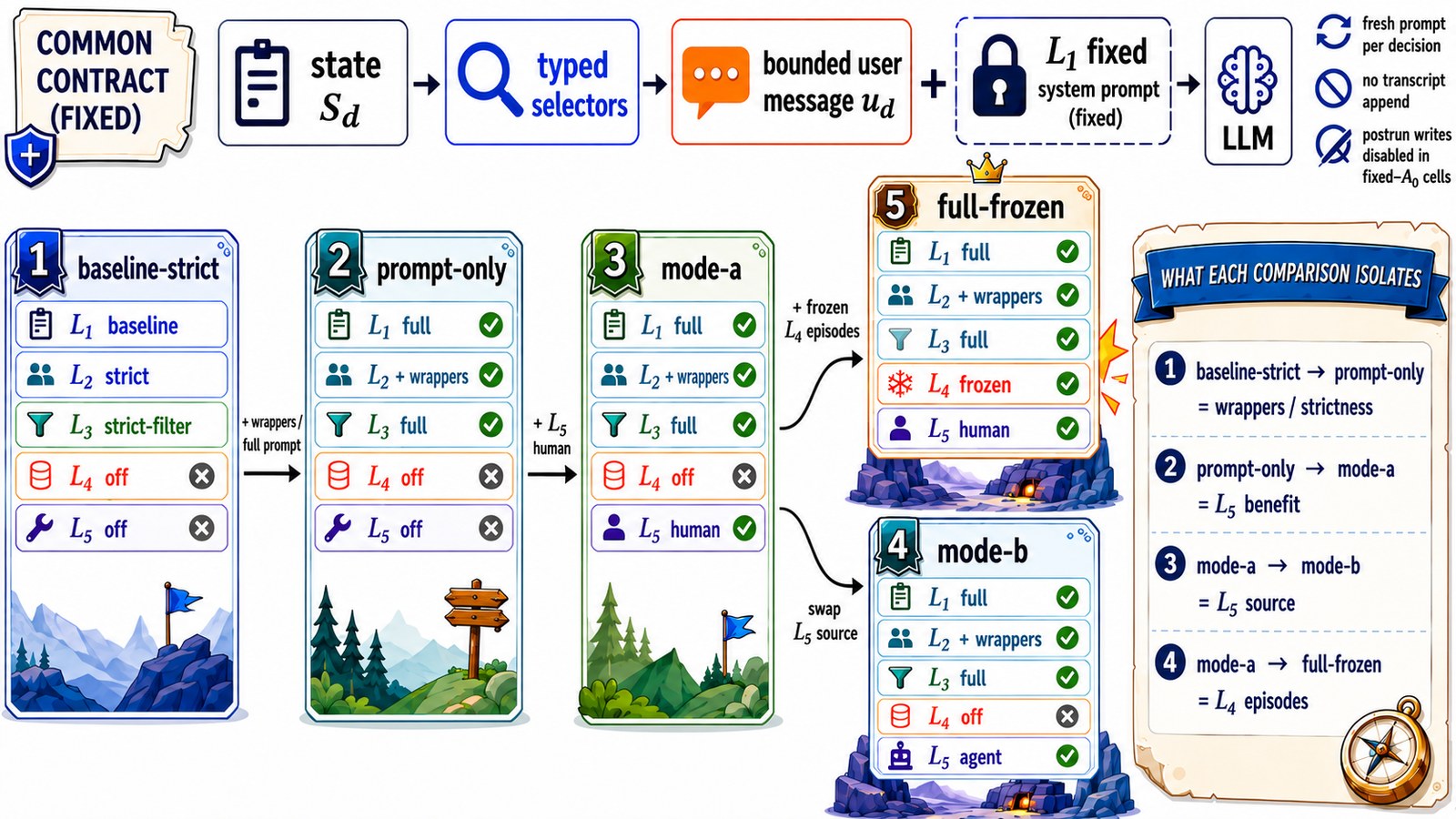
A five-cell, fixed-A0 ablation isolates each scaffold. Because context reaches the model through named slots, prompt strictness, episodes, and skills switch on and off independently.
Five-cell fixed-A0 ablation design.
Cell
L5 skills
L4 episodes
Wins
Mean score
baseline-strict (no scaffold)
—
—
3/10
70.4
prompt-only
—
—
4/10
69.6
mode-a (hand-authored skills)
✅ A
—
6/10
85.5
mode-b-frozen (template-filled skills)
✅ B
—
6/10
83.3
full-frozen (skills + episodes)
✅ A
✅
6/10
82.1
N=10 per cell; Wilson 95% CIs [11,60] / [17,69] / [31,83] for 3/10 / 4/10 / 6/10. At equal prompt setup, Δ(prompt)=+1/10 while the largest observed difference is Δ(L5)=+2/10. At N=10 this is directional, not statistically significant (Fisher exact p≈0.37; pooled scaffolded-vs-not p≈0.148; CIs overlap). Whether the bounded contract beats a matched accumulating-context design is left to a controlled follow-up.
Ascension ladder & cross-backbone probe
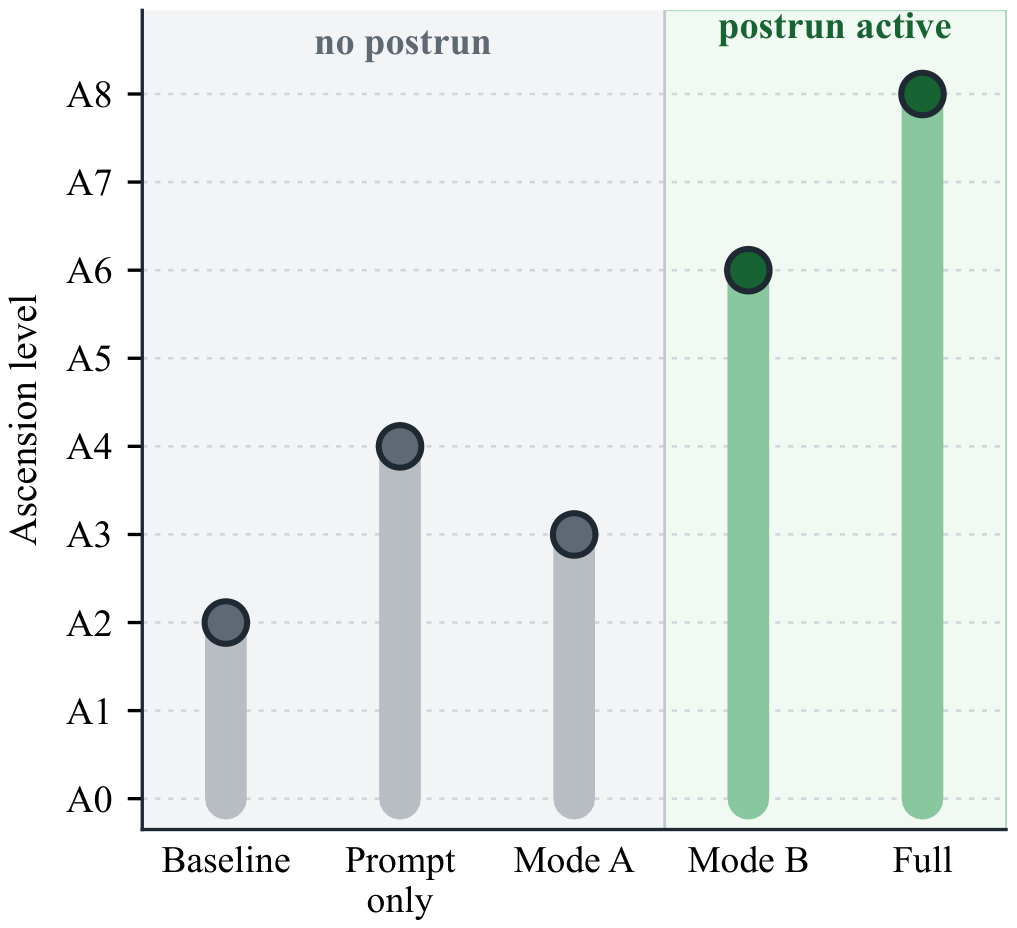
In the released ladder, postrun-writable L4+L5 streams attempt ascension A6–A8; no-postrun streams stop at A2–A4. Applying the Gemini-trained stack to other backbones is a diagnostic probe, not a controlled transfer study — and it is backbone-sensitive.
Auto-mode ascension ladder.
Backbone
Wins
Score
Δ%
Qwen 3.6-27B
0/5 → 0/5
14.6 → 26.9
+84.5
DeepSeek V4-Pro
0/5 → 0/5
41.3 → 33.8
−18.1
Gemini 3.1-Pro
3/10 → 6/10
70.4 → 82.1
+16.6
Frozen-stack transfer (no-store → with-store). An empirical property of this release, not a premise.
Against accumulating-context agents
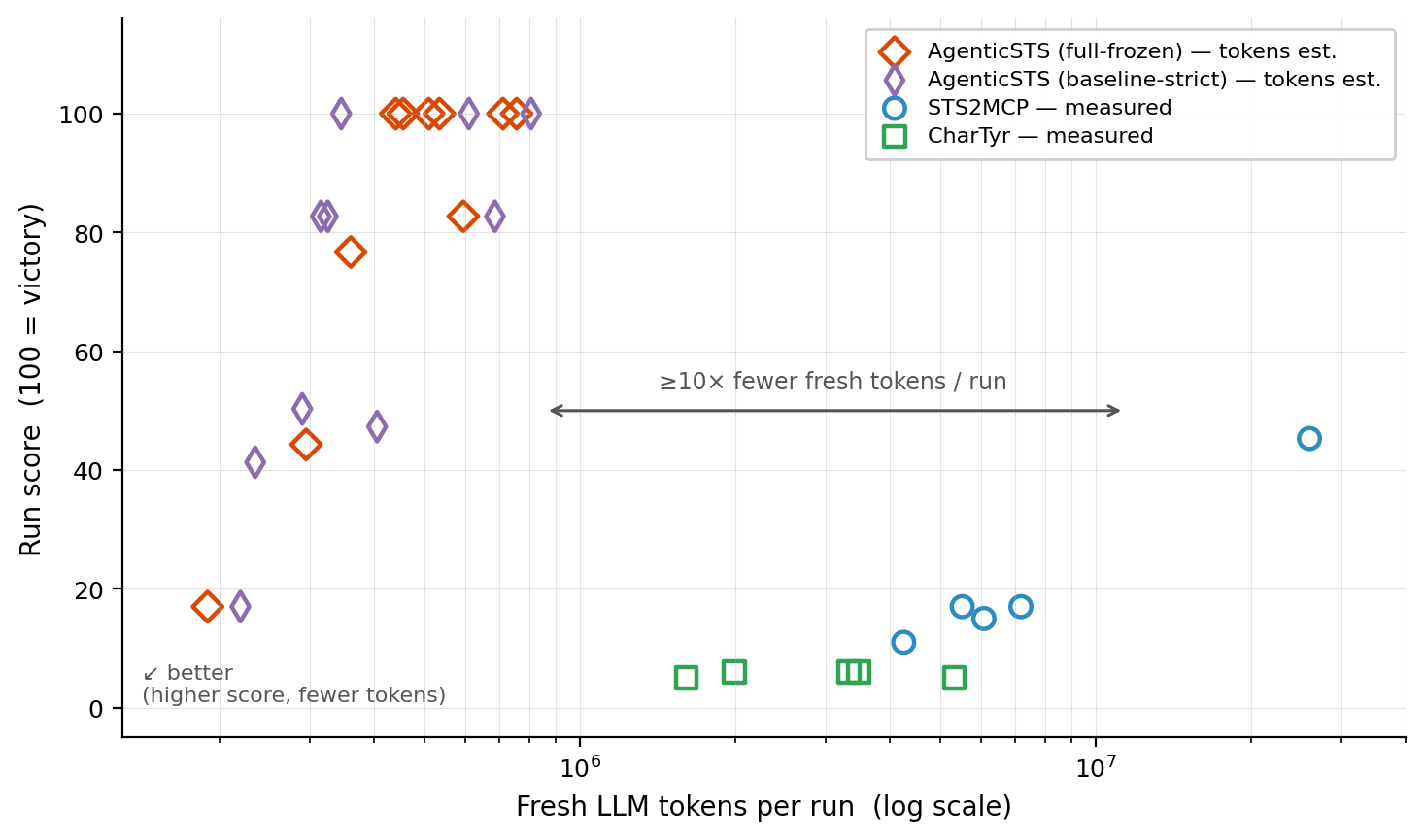
Both open-source StS2 agents re-send a single growing chat transcript on every decision. On Silent-A0 with the same strategic model for all agents, they win 0/5 each, need ~4× the wall-clock per floor, and spend 66–90× more fresh (non-cached) tokens per score point. Per-call prompts grow from ~9k toward ~500k tokens within one run; the bounded contract's stays flat.
Cost-effect frontier: score vs fresh LLM tokens per run.The token comparison is honest-but-asymmetric: ours is an estimate (strategic calls × ~5k user-message tokens), competitors are measured fresh non-cached tokens, and part of the gap is decision batching (one strategic call drives several actions). A ≥7× advantage holds even under an intentionally absurd upper bound. Full accounting in the paper and the repo's RESULTS.md.
Citation
Cite this work
A preprint is on arXiv (arXiv:2607.02255) and Hugging Face Papers; the paper is also under EMNLP 2026 ARR review. If you use this testbed, the trajectories, or the bounded-contract design, please cite:
@article{agenticsts2026,
  title         = {AgenticSTS: A Bounded-Memory Testbed for Long-Horizon LLM Agents},
  author        = {Cheng, Xiangchen and Jiang, Yunwei and Sun, Jianwen and Li, Zizhen and Li, Chuanhao and Cao, Xiangcheng and Liu, Yihao and Zhang, Fanrui and Jin, Li and Zhang, Kaipeng},
  year          = {2026},
  eprint        = {2607.02255},
  archivePrefix = {arXiv},
  url           = {https://arxiv.org/abs/2607.02255}
}